
Visual
The life-like painting by French artist Gustave Caillebotte is considered one of his best works to date. It is a large oil-based painting that shows various individuals walking on a rainy day through the Place de Dublin and epitomized the modern paradigm best Bitcoin casino. And even though this one is regarded as an Impressionist work of art, this masterpiece by Caillebotte is different for its apparent linearity and realism as compared to regular brush strokes.
Whistler’s Mother, or Arrangement in Grey and Black No. 1, as it’s actually titled, speaks to the artist’s ambition to pursue art for art’s sake. James Abbott McNeill Whistler painted the work in his London studio in 1871, and in it, the formality of portraiture becomes an essay in form. Whistler’s mother Anna is pictured as one of several elements locked into an arrangement of right angles. Her severe expression fits in with the rigidity of the composition, and it’s somewhat ironic to note that despite Whistler’s formalist intentions, the painting became a symbol of motherhood.
Pollice Verso, or the Turned Thumb, became a painting that was reputedly used as the primary inspiration for the movie Gladiator. The painting portrays the drama of the gladiatorial spectacle. The Colosseum spectators show the ‘thumb-down’ sign to the victorious gladiator as he stands with his foot on the defeated gladiator’s throat, who is pleading for mercy with his two fingers raised in the air.
Retro graphic
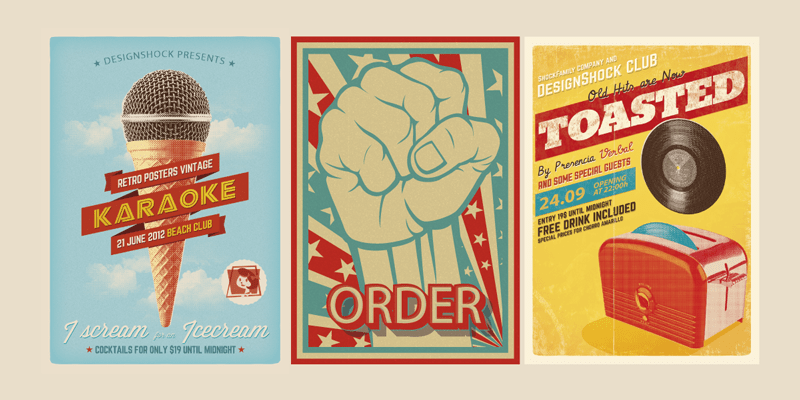
Things that were popular in the past trended for a reason, and there’s no reason why they can’t be popular now. Retro design, even if somewhat muddled and widespread, can be just as effective and appealing now as it was back then.
When using lines as separate elements in your design, you can incorporate them both parallel to the basic shapes within your logo, and perpendicular to the shapes (cutting across them) to help text and other elements stand out.
Optical Art was a term coined in 1964 by Time magazine to describe a form of abstract design that created illusions using positive and negative space. It fast became one of the biggest trends of the decade. Sometimes generating a sense of movement, sometimes revealing different scenes depending on the viewer’s focus, Optical Art plays upon the figure-ground relationship.
First, for obvious reasons, you need to pick the decade that you wish your viewers to reminisce about through the use of retro in design. But it is not that simple. There are tons of options to select from, and it is easy to get confused when picking a decade to ruminate. Sometimes, the 20’s design looks like a 30’s design, and certain elements that were popular or common in the 60’s might be echoed in the 80’s or 90’s. Design comes from design; inspiration begets inspiration.
Even though the industry constantly adopts new design trends, the significance of retro design is increasing. Things that were once obsolete are now new again; old trends and designs are now brought out, dusted, and put into use, thus proving their point.
Nostalgic graphic design is not just about bringing back old aesthetics-it’s about creating emotional connections with audiences. By integrating vintage elements into branding, businesses can evoke trust, warmth, and a sense of familiarity that sets them apart. If you’re looking to enhance your brand identity with nostalgic design, our services can help.
Cinematic artwork
The first scenes of Pierrot le fou begin with Jean-Paul Belmondo in the bath, reading from his copy of Elie Faure’s Histoire de l’Art. An essential reference within art criticism, this book reappears across the film in the form of different passages. A few moments later, in Marianne’s apartment, art meets film once more. With posters and postcards, we recognize the works of Henri Matisse and Pablo Picasso spread across her bare walls. Although it may not be glamorous, Godard’s choice of decor for Marianne’s apartment more closely resembles how many of us appreciate masterpieces: from a distance. Who hasn’t displayed their adoration for an artist in a gift shop?
Although critically praised, Herbert Ross’ film was a financial flop, grossing less than half of its total budget. Lead actor Steve Martin attributed this to philistine audiences being unable to accept him in a serious role,
Have you ever watched a movie and felt a strange sense of familiarity, as if you’ve seen it somewhere before? This déjà vu might stem from the canvas, not the screen. Films often draw inspiration from the world of painting, with directors using iconic artworks to enhance the visual storytelling of their movies. Today, we delve into ten masterpieces that have not just influenced, but directly shaped, some of cinema’s most unforgettable scenes.
Among the numerous artworks displayed, there’s Picasso’s Portrait de Sylvette (1954) and Jacqueline aux fleurs (1954). Godard strategically places these two left-facing artworks side by side, with Pierrot looking in the opposite direction… In cinematographic fashion, Godard creates art from art, relying on Picasso’s work to compose his own masterful frames.
These films showcase the profound impact that art can have on cinema. By borrowing elements from these masterworks, filmmakers not only pay homage to the artists but also enrich their own visual storytelling. As we see, the line between the canvas and the camera is often beautifully blurred, creating a rich tapestry of artistic expression that transcends mediums.